Artikel liegen derzeit auf Englisch vor; der Rest der Seite folgt Ihrer gewählten Sprache.
Network Ports Every Developer Should Know

:22, :443, :5432, :6379… If you're a developer, you type these numbers almost every day.
The simplest way to think about it: the IP address is the building, and the port is the door to one specific app inside it. One server can run SSH, a web server and a database at the same time, and the port number is how a connection says which of them it wants.
AlgoInsight made a short video that breaks down fourteen ports every developer should know, from SSH and HTTPS to PostgreSQL, Redis, Kafka and Elasticsearch.
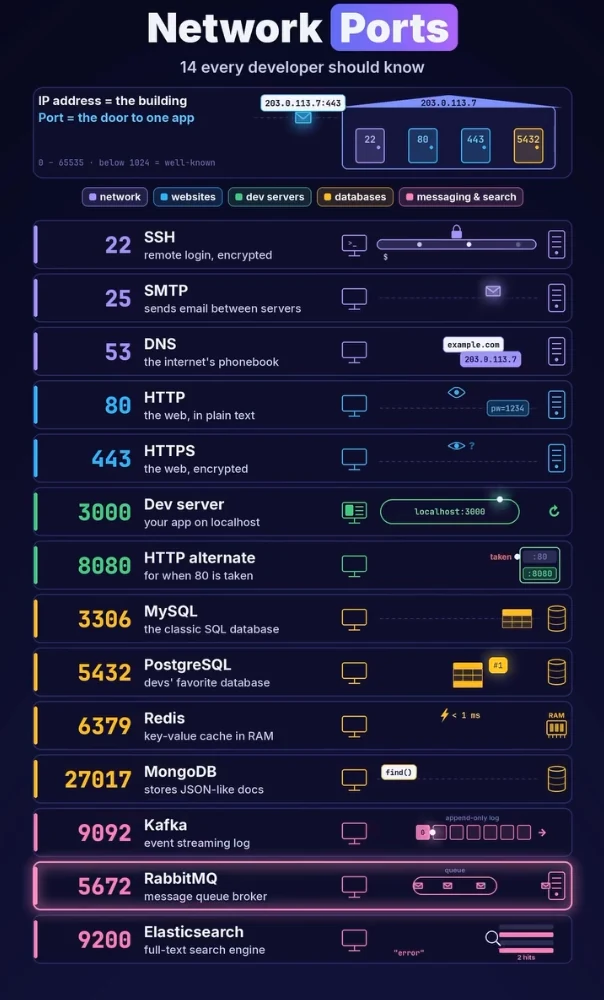
The fourteen
| Port | Service | What it's for |
|---|---|---|
| 22 | SSH | Remote login and file transfer, encrypted |
| 25 | SMTP | Sending email between servers |
| 53 | DNS | Turning names into IP addresses |
| 80 | HTTP | The web, in plain text |
| 443 | HTTPS | The web, encrypted |
| 3000 | Dev server | A Node, React or Next.js app on localhost |
| 8080 | HTTP alternate | Proxies and app servers when 80 is taken |
| 3306 | MySQL | The classic SQL database |
| 5432 | PostgreSQL | The other classic SQL database |
| 6379 | Redis | In-memory cache and key-value store |
| 27017 | MongoDB | Document database |
| 9092 | Kafka | Event streaming |
| 5672 | RabbitMQ | Message queues |
| 9200 | Elasticsearch | Full-text search |
Ports below 1024 are the "well-known" range. On Linux and macOS, a program usually needs elevated privileges to listen on one, which is why development servers pick numbers like 3000 and 8080.
One addition from my own backend work
If you build with Laravel, Django or FastAPI, your local dev server runs on 8000 by default, not 3000: php artisan serve, python manage.py runserver and uvicorn all start there.
Which port do you type the most?
First shared on LinkedIn.